
Training is delivered on behalf of MCX Training & Development, registered QQI QA Centre No. 38332N. MCX Training and Development has agreed its Quality Assurance policies with QQI. As a result learners and potential learners need to be informed of the following:
Learner effort is based on the time taken by typical learners at QQI – Quality and Qualifications Ireland – the national accreditation body – Level 6 (a single award component is worth 15 credits on the National Framework of Qualifications) to achieve the learning outcomes. It includes:
- Guided learning hours of (usually) five full contact days with a specified number of people
- Self directed learning, review, reflection and preparation between each contact day, with access to online forum and resources https://mcx.ie/learner-forum/
- Application of the learning in a personal or professional setting
- Assessment after completion of contact hours that is submitted within two weeks of completion of delivery of the programme

“Learner effort is based on the time taken by typical learners at QQI Level 6.”
2. Diversity/Equality/ Reasonable Accommodation
MCX Training & Development delivers all programmes without discrimination on the legally stated nine grounds (race, age, gender, sexual orientation, disability, membership of the travelling community, religion, marital status and family status) with respect to access, delivery and assessment.
In accordance with the Equal Status Act, 2000 to 2004 MCX Training & Development ensures that selection procedures, entry requirements and programme content, delivery and assessment are adaptable to facilitate learners with a particular need, such as physical special need and/or other learners covered by equality legislation. This intervention or specific support service provided through the Training Manager guarantees the learner or group of learners can be successfully catered for to ensure he/she can best participate in learning.
Any adaption of the assessment by the assessor will facilitate the learner to demonstrate their achievement of the standards without significantly altering the standard. The adaption will amend the aspects of the assessment technique or instrument which prevent a learner’s participation in the assessment. It is applicable where a particular assessment technique or instrument disadvantages the learner in assessment.
3. Entry Level Requirement
MCX Training & Development offers a programme of training that gives recognition to each learner’s skills, knowledge and attitude – the overall competency. The Programme is suitable for those with a minimum Level 5 qualification or equivalent relevant life and work experience. This is essential for certification purposes. Proficiency in the English language is a requirement.
MCX Training & Development operates an RPL (Recognition of Prior Learning) policy with regard to entry to, credit towards and access to an award. RPL is a method of assessment which may allow learners to gain recognition for skills, knowledge and attitude that they may already have. Learners are requested to contact the trainer directly if they feel that RPL relates to their circumstance.
MCX Training & Development operates a process of progression. This refers to how learners can move on to higher level programmes. Each QQI certificate component is allocated a fixed number of credits. Each level 6 component award, offered by MCX Training & Development is worth 15 credits on the National Framework of Qualifications www.nfq.ie A full listing of QQI approved modules available can be accessed at www.mcx.ie or www.qqi.ie
4. Assessment
All programmes are assessed in line with the stated assessment criteria as detailed in the relevant module descriptor. MCX Training & Development uses a common approach in that all assessments are written, hard copy assignments, plus practical, video-recorded sessions. Should a learner wish to clarify the assessment requirements, this can be achieved by discussing directly with trainer or contacting MCX Training & Development directly at: joanne@mcx.ie The trainer also acts as the internal assessor. The results are then subject to internal verification, external authentication and a results approval panel. Provisional results are communicated by the training manager to the learner after internal verification, subject to the external authentication process and results approval process.
Each learner receives an assessment brief specific to each assessment. An Assessment Brief is a set of written instructions outlining what the learner is required to do for each assessment. It should outline the evidence expected, how the assessment will be marked and the deadline for completion. You will receive an assessment brief with your training manual.
Approved results are issued to learners subject to the appeals process after both external authentication and results approval panel have been completed. All programmes are assessed in a fair and consistent manner as per MCX Training & Development’s agreed Quality Assured system, policies and procedures.
MCX Training & Development will deal with any errors, omissions and/or deliberate acts by learners or trainers that may impact on the validity of the assessment process in a consistent, transparent and timely manner.
4.1 Submission policy
MCX Training & Development is a learner centred company and will always work with a learner to facilitate the submission of an assignment and hence, will take each case on its own merits. The learners are aiming for a QQI level 6 component award. Assessment documents must be submitted by post to the trainer’s address within two weeks of the final contact day of the course.
The learner will receive provisional results once the assignments have been assessed and internally verified – usually within 4 to 5 weeks of receiving all assignments.
The final results and approximate date to receive the QQI Level 6 certificate are issued after results have been through the results approval process – internally assessed, internally verified, externally authenticated, and approved by the Results Approval Panel. Final results are submitted to QQI as per QQI criteria for submission https://www.qqi.ie/Downloads/QQI%202019%20Key%20Dates.pdf
4.1.1 Assessment Submission Details
- A hard copy of the assessments should be posted, in typed word-processed format, two weeks after the last day of the programme:
| MCX Training & Development, The Glen, Faithlegg, Co. Waterford X91N2R7 |
- Email joanne@mcx.ie to confirm you have submitted your assignment for assessment. Your provisional result will be emailed back to this address
- After the results approval process you will receive your final result with instructions should you wish to appeal your result (within 14 days of date of email)
- Binding is not required and a single staple in the top left-hand corner is sufficient
- Please ensure that you have signed and returned the Learner Testament at the end of this document.
Note:
QQI Certification happens on a fixed date every two months. In the email with your final results, you will be informed as to when you can expect to receive your certificate. All certificates will be sent from our offices to our client. We do not send certificates to individual learners.
Your certificate is a very important document. Should you lose or misplace it, there is a cost involved to get another. Here are the details https://qhelp.qqi.ie/learners/lost-certificate/
4.1.2 Late Submissions Policy
MCX Training & Development’s policy on late submissions is as follows:
- A learner may request an extension in writing for up to three months after the completion of the programme with a specific reasonable excuse
- If a learner does not request an extension, and then submits an assignment for assessment after the deadline date and within three months of completion of the programme, then a fee of €30 applies
- If a learner makes contact after three months (and before six months) of completion of the programme to now submit an assignment for assessment, then the learner will be asked to attend (re-sit) one specific day of a five-day programme, at a time and venue that is reasonable and suits the learner. A fee of €30 applies.
- If a learner makes contact to submit an assignment for assessment after six months (or longer) of completion of the programme, then assignment cannot be accepted, but all best practice and learner centred approaches will be used to discuss way forward with the learner. A fee of €100 applies
MCX Training & Development will judge each application for compassionate consideration or extenuating circumstances on its own merit.
Examples of circumstances under which a provider may consider giving compassionate consideration include:
- Physical injury or emotional trauma
- Physical disability or chronic or disabling condition such as epilepsy, glandular fever or other incapacitating illness of the learner
- Recent bereavement of close family member or friend
- Severe accident
- Domestic Crisis
- Terminal illness of a close family member
- Other extenuating circumstances.
Learners seeking compassionate consideration will be required to provide appropriate evidence/ documentation, for example, a statement from a medical practitioner. Please follow submission requirements as detailed in the learner assessment brief.
4.2 Plagiarism
Plagiarism is defined as follows: “to copy another person’s ideas, words or work and pretend that they are your own’ (Oxford English Dictionary). Plagiarism is forbidden in any assessments for programmes delivered by MCX Training & Development. Where plagiarism is seen to have occurred, the learner is communicated with, by email and provided with a mechanism to respond. If the plagiarism is validated, the learner’s assessment is deemed invalid and will not be processed for certification.
4.3 Malpractice
MCX Training & Development reserves the right to investigate and deal with any form of assessment malpractice which could impact on the validity of assessment. Learners sign the Learner Testament which declares that the work is wholly their own original work.
Examples of Malpractice include:
- Plagiarism
- Impersonation of another learner
- Fabrication of evidence
- Alteration of results
- Wrongly obtaining secure assessment material e.g. examinations
- Behaving in any way such as to undermine the integrity of the Assessment Process
Allegations of malpractice will be investigated by the trainer within a timescale that does not disadvantage a learner against whom an unproven allegation is made.
4.4 Integrity of Assessment
MCX Training & Development will ensure the integrity of the assessment process with the assessor. The role of the assessor is to evaluate learner evidence and make the assessment decision/judgement on whether the outcomes, of knowledge, skill and attitude as outlined in the QQI Module descriptor have been achieved. The assessor will determine that the evidence is valid, reliable and sufficient to make the assessment decision.
The assessor is a qualified practitioner, usually the trainer, who has the responsibility for the assessment of learners. It can also be a workplace supervisor, manager or team leader but will have the subject matter/technical expertise, i.e. they are proficient in the subject/technical area in which they are assessing. Learners will be advised on the allocation of marks /marking criteria in the Learner’s Brief.
The trainer is available day or night, including weekends for any queries, assistance and support throughout the duration of the entire training programme.
“MCX Training & Development will ensure the integrity of assessment process ”
5. Appeals Process
Learners wishing to appeal results should contact the QA Centre, MCX Training & Development directly, by email within 14 days of issue of final results. The appeals process and application form will be attached to the final results email. There is a nominal fee. The appeal will be addressed by the Results Approval Panel who will recommend appropriate action.
The appeals process enables learners to appeal:
- The Assessment Process, if they perceive there to be irregularities/inequality in its implementation
- The Assessment Result
Approved, final results can be formally appealed by the Learner. The only evidence which may be presented at appeal is that which has already been submitted for assessment. New evidence may not be added for the appeal.
Learners will be informed of the outcome of the Appeals Process within an agreed timescale.
Following the completion of the providers’ appeals process, the results for the learner concerned are forwarded to QQI as the final result. These final results are the basis on which QQI will issue certificates.
QQI operates a national appeals process. This is only on the basis of:
- The completion of the provider’s appeals process, and
- Appealing the process, not the result.
QQI only accepts appeals from the provider, MCX Training & Development and will not accept an appeal on behalf of a learner until that appeal has gone through ‘due process’ within MCX Training & Development’s appeals process and all opportunities to appeal with this process have been exhausted.
6. Security / Learner Confidentiality
All learner records are stored securely by the centre and all information relating to learners is treated in a confidential manner, in line with the MCX Training & Development Data Protection Policy. All learner records held in a hard copy are destroyed, by shredding, one year after the completion of the programme, with each learner informed of that during the training programme and signing the Testament with this point included.
7. Feedback
7.1 Continuous feedback from learners
All learners are encouraged to provide continuous feedback on programme access, delivery and assessment. There is a formal process upon completion of the programme and learners are encouraged to provide feedback directly to trainers throughout the programme. This feedback is captured in the Trainer’s Report. Learners can also email the centre directly at joanne@mcx.ie
An evaluation sheet is completed by each learner at the end of each programme while verbal feedback is solicited at the end of a session.
At the commencement of each programme the trainer will begin with a contracting exercise. This will consist of facilitating the group to detail the specific learning outcomes they wish to achieve from the programme, outlining the learning objectives of the programme and then confirm what expectations can be achieved and clarify expectations that are not addressed by the programme.
7.2 Feedback to learners
MCX Training & Development is committed to providing timely and constructive feedback to learners throughout the training programme. It may be communicated to the learner by phone or email, or through the Learner Forum on the website, for all learners.
8. National Framework of Qualifications
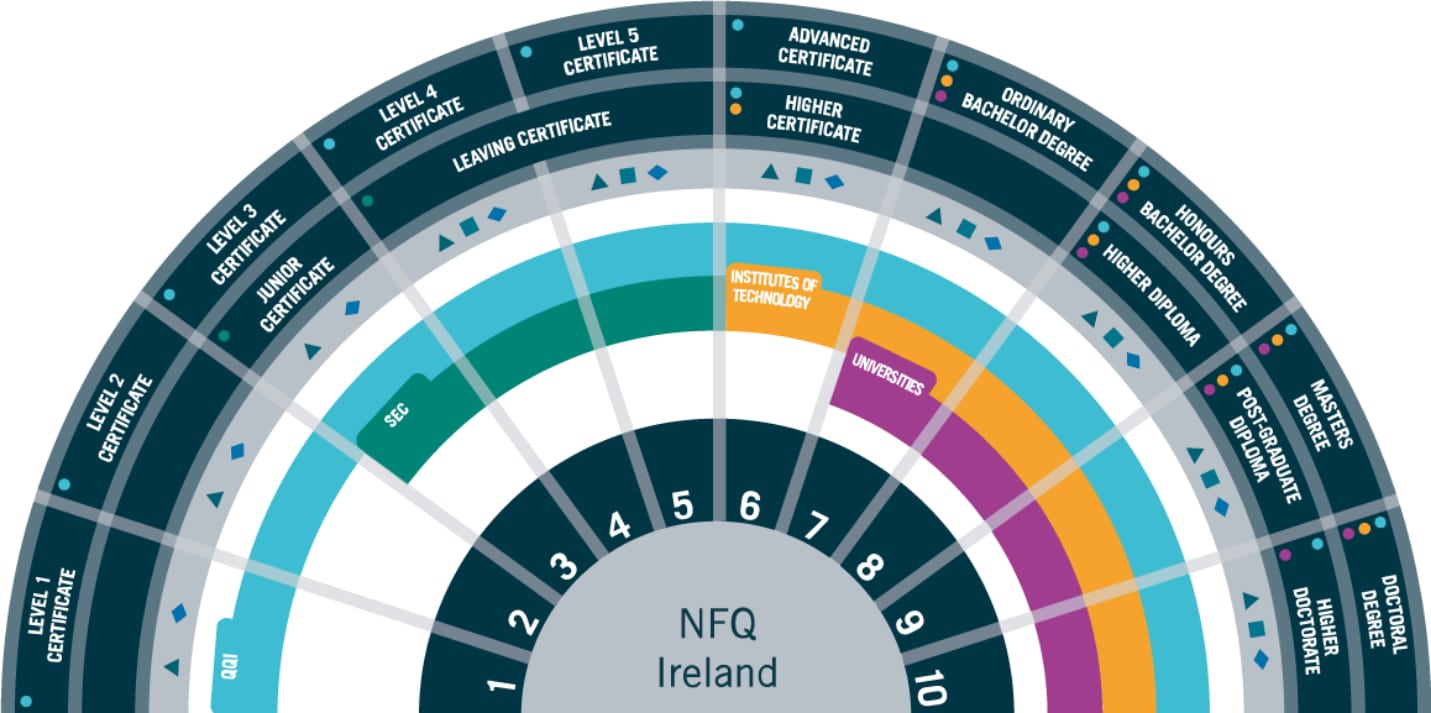
The National Framework of Qualifications comprises of 10 levels. It accommodates awards gained in schools, colleges, universities, work-places and training centres from the most basic (QQI Level 1) to the most advanced (Level 10) levels of learning. QQI – Quality and Qualifications Ireland – has responsibility for making awards on the framework (www.QQI.ie).
The Framework helps to provide clarity to employers, learners and the public on the type and level of qualifications available in Ireland. The Module Descriptor and Learner Brief details the level of this qualification. This training programme is certified by QQI on the national framework of qualifications at level 6. The following graph details the ten levels on the National Framework of Qualifications: (www.nfq.ie for further information)
9. Health & Safety
MCX Training & Development is committed to assuring that all programmes, assessments and related services are delivered in accordance with current Health & Safety legislation. At the commencement of programmes learners will be advised of all health and safety matters by the trainer. During learner induction learners are briefed on evacuation and other safety related procedures. Where the programme is delivered in rented or learner facilities the centre will request that the owner meets Health & Safety requirements.
10. Learner Protection
MCX Training & Development does not currently provide programmes of three months or more in duration and therefore not subject to section 43 of the Qualifications Act.
Contact Us


